


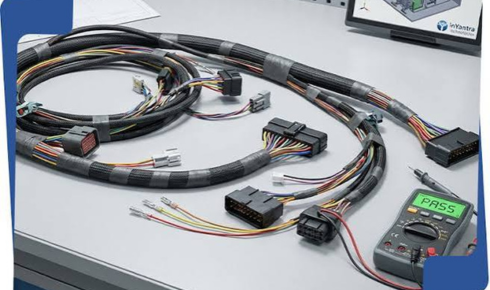
Wiring looks simple until it is done at scale. A prototype can be hand-wired by a good technician in an afternoon, but producing five hundred identical, fully tested wire bundles a month, each with dozens of terminations that must never fail in the field, is a manufacturing discipline in its own right. Across India’s defence, railway, machine tool and energy sectors, original equipment manufacturers are steadily concluding that this discipline belongs with specialists, and the cable harness industry has grown rapidly in response. This article examines what is driving the shift and what buyers should demand from a harness partner.
What a Cable Harness Assembly Actually Involves
A harness is far more than cut wires with connectors on the ends. A proper build sequence covers cable selection and cutting, contact crimping with calibrated tooling, connector assembly and torque control, routing and bundling to a formboard, protective sleeving or braiding, identification marking, and finally electrical testing of every conductor. Each step has failure modes that only reveal themselves months later in the field: an under-crimped contact that passes initial inspection, a bend radius violation that fatigues a conductor, a missing strain relief that transfers vibration straight to a solder joint. Process control, not individual skill, is what prevents them.
Why OEMs Are Outsourcing
The first reason is quality consistency. Specialist harness manufacturers run calibrated crimp tools with pull-test verification, maintain workmanship standards aligned to IPC/WHMA-A-620, and test every assembly for continuity and insulation resistance before despatch. Replicating this in a corner of a machine assembly shop is possible but rarely economical. The second reason is capacity flexibility; harness demand in project-driven industries is lumpy, and a specialist absorbs the peaks. The third is focus. Every hour an OEM’s engineers spend supervising wire cutting is an hour not spent on the product that actually differentiates the company.
The Hidden Costs of In-House Wiring
In-house wiring carries costs that seldom appear on any spreadsheet: tooling calibration, operator training and certification, incoming inspection of wire and terminals, quarantine of suspect batches, and the engineering time consumed by field failures traced back to terminations. When these are honestly accounted for, the make-versus-buy decision usually tilts towards buying from a specialist, particularly for safety-relevant applications.
Quality and Testing Expectations
Buyers should be explicit about acceptance criteria. Insist on one hundred percent continuity and hipot testing with recorded results, crimp height monitoring and periodic pull tests, traceability of connectors and contacts to their manufacturing batches, and clear workmanship standards in the purchase specification. For defence and railway work, ask how the harness maker controls counterfeit-part risk in its supply chain. A serious supplier will welcome these questions; evasiveness is itself a test result.
Why Connector Expertise Changes the Outcome
The most failure-prone points of any harness are its terminations, which is why the best harness partners are fluent in connector engineering. When the harness builder is also a connector manufacturer, correct contacts, tooling, backshells and strain reliefs are guaranteed by design rather than by hope. This matters most where mil grade connectors are specified, because military-specification interconnects demand precise crimp tooling and assembly torques that generic wiring shops frequently get wrong. A single engineering team accountable for both the connector and the finished loom eliminates the classic blame triangle between connector vendor, harness shop and OEM.
Involve the Harness Partner at the Design Stage
The largest savings come not from outsourcing the labour but from involving the harness manufacturer while the design is still fluid. An experienced partner will flag connectors that are difficult to assemble, suggest standard insert arrangements in place of exotic ones, rationalise wire types across the bill of materials and design the loom for the realities of installation on the shop floor. This design-for-manufacture review typically trims both cost and failure risk before a single wire is cut, and it is a service that pure trading suppliers simply cannot offer.
The India Advantage
Sourcing cable harness assembly in India has become a strategic choice rather than merely a cost decision. Defence indigenisation policy rewards domestic content, the railway expansion is consuming harnesses at an unprecedented rate, and global OEMs manufacturing in India want suppliers within driving distance of their plants. Established connector manufacturers in India have extended naturally into harness manufacturing, offering qualified components and finished assemblies from a single source. Allied Electronics Corporation of Mumbai, a connector maker since 1966 that also builds harness assemblies, is representative of this integrated model. For buyers, the combination of local engineering support, approvals from bodies such as the Ministry of Defence and RDSO, and short logistics chains is difficult for offshore suppliers to counter.
Conclusion
Cable harnessing rewards specialisation, and the Indian supply base is now mature enough that OEMs no longer need to choose between quality and proximity. If your production still includes in-house wiring, run an honest costing of it, then invite a specialist harness manufacturer, ideally one with its own connector manufacturing, to quote against a clear technical specification. The comparison is usually illuminating, and the conversation costs nothing.
Hyperlink Summary
- Anchor Text 1: “cable harness assembly in India” → https://aecconnectors.com/cable-harness-assemblies.html
- Anchor Text 2: “mil grade connectors” → https://aecconnectors.com/ms-connectors.html
- Anchor Text 3: “connector manufacturers in India” → https://aecconnectors.com/